As an Amazon Associate, top7tools.au earns from qualifying purchases. Product prices and availability are accurate as of the date/time indicated and are subject to change. Any price and availability information displayed on amazon.com.au at the time of purchase will apply.
Rankings re-checked weekly · Last re-checked 14 October 2026
·Prices updated daily·AI-assisted, run by Jaco Olwagen
3 quick taps — we'll match you to a pick using the same scores we rank with.
The picks, in order
7 picks
Number one at the top, number 7 at the bottom. The tier label on each card says which price bracket it sits in.
★Editor's Choice
1
BLUETTI
BLUETTI Elite 200 V2 Portable Power Station (2073.6Wh, 2600W LiFePO4)
2073.6Wh LiFePO42600W AC6,000+ Cycles
Premium
Rank #1
BLUETTI Elite 200 V2 Portable Power Station (2073.6Wh, 2600W LiFePO4)
Our Verdict
The pick for the reader who needs two kilowatt-hours: enough to carry a fridge and freezer through a full day's blackout or run a caravan's 240V loads, recharged from the wall in about 70 minutes and sold by Bluetti's own Australian store with a five-year warranty.
Why it's number one: Leads the category on capacity (2,073.6 Wh) and pairs 2,600 W continuous output with the longest rated cycle life here (6,000+ cycles to 80%), backed by a 5/5 from Trusted Reviews and a 4/5 from TechRadar.
The Elite 200 V2 is for the reader whose loads have outgrown the 1kWh class: a caravan running a kettle, microwave and fridge off-grid, a tradie powering a mitre saw on a lot with no mains yet, or a household that wants the fridge, freezer and modem to ride out a summer storm outage for a full day. The 2,073.6Wh LiFePO4 pack is rated for more than 6,000 cycles to 80%, well past the 3,000 to 4,000 most rivals quote, and the inverter delivers 2,600W continuous with a 3,900W Power Lifting mode for resistive loads like heaters and kettles. The AU version has four 240V outlets, two 100W USB-C ports, two USB-A ports and a 12V car socket. Bluetti quotes 80% from the wall in 1.1 hours on TurboBoost, and Trusted Reviews measured a full recharge in 69 minutes; solar input takes up to 1,000W at 12 to 60V. It works as a UPS for a modem or a NAS. Trusted Reviews gave it 5/5 and TechRadar 4/5 after 160 days of testing. The catches: at about 24kg it is a two-hand lift, it has no wheels, and unlike the DJI and EcoFlow picks it cannot take an expansion battery, so buy it for the capacity it has on day one. No solar lead is listed in the AU box. It is sold and shipped by Bluetti Energy, the brand's own Australian storefront, and the listing has only two ratings so far.
Capacity
10.0
Output
9.6
Charging
9.6
Build
9.3
Owners
8.5
Critics
9.0
Owners is the 5★ Amazon AU rating from 2 reviews, weighted toward the category average when there are few. Critics averages 2 published reviews. Tick marks show the category average.
How we scored it
Each measure is marked against the category's rubric, where 10 is the best you can buy, 8 is strong, 6 is basic but sound and 4 falls short. The bars show that mark on the Top7 scale (a 6 reads as 7.0, an 8 as 8.5); the notes quote the rubric mark.
Capacity 10.0 (rubric 10): 2,073.6 Wh LiFePO4 pack clears the 2,000 Wh line for 10.
Output 9.6 (rubric 9.5): 2,600 W continuous is the 2,000 to 2,999 W band at 9, plus 0.5 for four AC outlets on the AU version; the USB-C ports top out at 100 W, so no USB-C bonus.
Charging 9.6 (rubric 9.5): Bluetti quotes 80% in 1.1 hours on TurboBoost and Trusted Reviews measured a full recharge in 69 minutes, the 61 to 90 minute band at 9, plus 0.5 for 1,000 W of solar input with no proprietary adapter needed.
Build 9.3 (rubric 9): More than 6,000 cycles to 80% scores 9; UPS mode is supported but Bluetti publishes no switchover time, so no UPS bonus, there is no expansion battery, and the five-year warranty is stated.
The DELTA 3 Plus that held this slot lost its Amazon AU offer, and the DELTA 3 (1500) is the natural step up rather than sideways. EcoFlow rates it at 1,536Wh, 128Ah at 12V, in the same case size as the older DELTA 2, which is the headline: it is half again the capacity of every other 1kWh-class unit in this ranking for a price that still sits under the DJI at the top. The inverter is 1,800W continuous, with X-Boost lifting resistive loads such as kettles, ovens and hair dryers to around 2,200W, so it runs a household kettle without complaint but will not start anything large with a motor. Charging is the other reason to pick it: 1,500W of mains input takes it 0 to 100 percent in 90 minutes. The pack is third-generation LiFePO4 rated at 4,000 cycles to 80 percent, which is a quarter more than the 3,000-cycle units here and works out at roughly ten years of weekly cycling, and it stacks with DELTA 2, DELTA 3, DELTA 2 Max and DELTA Pro 3 extra batteries from 1.5kWh up to 5.5kWh, so it grows into a home backup system rather than being replaced by one. UPS switchover is under 15ms, enough for a desktop, a NAS or a 3D printer, though it is not the sub-10ms figure the DELTA 3 Plus claimed. Two cautions. At 23kg this is a two-handed lift and a fixed installation more than a camping unit. And the Amazon AU listing has only a couple of ratings so far, so the 5.0 average means nothing yet; you are buying EcoFlow's track record, not this listing's. Sold by EcoFlow-AU with 240V Australian outlets and a five-year warranty on the listing.
Capacity
9.3
Output
8.5
Charging
9.3
Build
9.6
Owners
8.5
Owners is the 5★ Amazon AU rating from 2 reviews, weighted toward the category average when there are few. Fewer than two published reviews of this exact model, so the owner rating carries that weight too. Tick marks show the category average.
How we scored it
Each measure is marked against the category's rubric, where 10 is the best you can buy, 8 is strong, 6 is basic but sound and 4 falls short. The bars show that mark on the Top7 scale (a 6 reads as 7.0, an 8 as 8.5); the notes quote the rubric mark.
Capacity 9.3 (rubric 9): EcoFlow rates the pack at 1,536 Wh, 128 Ah at 12 V, inside the rule's 1,500 to 1,999 Wh band.
Output 8.5 (rubric 8): 1,800 W continuous, about 2,200 W through X-Boost, which is the rule's 1,500 to 1,999 W band. Provisional: the listing states neither a 140 W USB-C port nor a fourth AC outlet, so neither bonus is applied.
Charging 9.3 (rubric 9): EcoFlow publishes 0 to 100 percent in 90 minutes on 1,500 W AC input, the top of the 61 to 90 minute band; no 1,000 W solar figure is claimed for this model, so no bonus.
Build 9.6 (rubric 9.5): Third-generation LFP rated 4,000 cycles to 80 percent scores 9, plus 0.5 for stacked expansion from 1.5 kWh to 5.5 kWh; UPS is under 15 ms so it misses the 10 ms bonus, and the listing states a five-year warranty.
Pros
+ 1,536Wh, half again the capacity of the 1kWh units, in a DELTA 2 sized case
+ 0 to 100 percent in 90 minutes on 1,500W mains input
+ 4,000-cycle LFP pack, a quarter more than the 3,000-cycle rivals here
+ Stacks from 1.5kWh to 5.5kWh with EcoFlow extra batteries
+ Sold by EcoFlow-AU with 240V outlets and a five-year warranty
Cons
− 23kg, so it is a two-handed lift rather than a camping carry
− Only a couple of ratings on the Amazon AU listing so far
− UPS is under 15ms, not the sub-10ms of the unit it replaces
− X-Boost drops voltage to run big resistive loads, which suits a kettle but not a motor
1536Wh LiFePO41800W Output90min Full Charge4000 CyclesUnder 15ms UPSExpandable 5.5kWhShips from AU
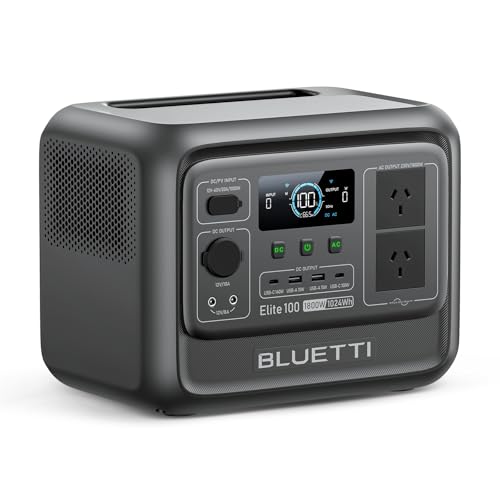
BLUETTI Elite 100 V2 Portable Power Station (1024Wh, 1800W LiFePO4)
1024Wh LiFePO41800W AC1000W Solar
Premium
Rank #3
BLUETTI Elite 100 V2 Portable Power Station (1024Wh, 1800W LiFePO4)
Our Verdict
The lightest 1kWh unit here at 11.5kg, with 1,800W output, 2,700W lifting power, 1,000W solar input, a 70-minute full charge and an MC4-to-XT60 lead in the box. Bluetti quotes over 4,000 cycles. Only seven ratings on the AU listing, and no stacked expansion.
Bluetti has trimmed this generation hard, and the result is the most portable of the three 1kWh units: 11.5kg and about 17 litres with a hidden top handle, against 12.9kg for the Anker and 12.5kg for the EcoFlow. Output is 1,800W continuous with Power Lifting to 2,700W for resistive loads, and the LiFePO4 pack is rated for more than 4,000 cycles to 80%. Charging is competitive: 1,200W TurboBoost mains input gets to 80% in 45 minutes and full in around 70, while solar input is 1,000W across a 12 to 60V window. Bluetti includes an MC4-to-XT60 solar lead in the box, which neither Anker nor EcoFlow does. The 10ms UPS switchover and 30dB fan noise make it a sensible bedroom or home-office backup. What it lacks is a native expansion port: Bluetti's B80 pack can feed it through the XT60 input in power-bank mode, but that is a top-up, not a stacked system, so if you want to grow into a caravan or house setup, look at the EcoFlow or DJI instead. The Amazon AU listing shows a 4.2 average from just seven ratings, which is a thin sample either way, and dispatch is quoted at four to five days. Sold by Bluetti Energy with 240V Australian outlets and a five-year warranty.
Capacity
8.5
Output
8.9
Charging
9.6
Build
9.6
Owners
8.3
Critics
8.0
Owners is the 4.3★ Amazon AU rating from 8 reviews, weighted toward the category average when there are few. Critics averages 2 published reviews. Tick marks show the category average.
How we scored it
Each measure is marked against the category's rubric, where 10 is the best you can buy, 8 is strong, 6 is basic but sound and 4 falls short. The bars show that mark on the Top7 scale (a 6 reads as 7.0, an 8 as 8.5); the notes quote the rubric mark.
Capacity 8.5 (rubric 8): 1,024 Wh LiFePO4 pack sits in the 1,000 to 1,499 Wh band at 8.
Output 8.9 (rubric 8.5): 1,800 W continuous (2,700 W Power Lifting) is the 1,500 to 1,999 W band; TechRadar and Trusted Reviews list a 140 W USB-C port for plus 0.5. Two AC sockets, so no outlet bonus.
Charging 9.6 (rubric 9.5): Bluetti quotes full in around 70 minutes on 1,200 W TurboBoost input, the 61 to 90 minute band, plus 0.5 for 1,000 W of solar input; an MC4-to-XT60 lead is in the box.
Build 9.6 (rubric 9.5): More than 4,000 cycles to 80% scores 9, plus 0.5 for the 10 ms UPS; no stacked expansion battery option, and a five-year warranty is stated.
EcoFlow RIVER 3 Max Portable Power Station (572Wh, 600W, Detachable Extra Battery)
572Wh LiFePO4600W ACDetachable Battery
Value
Rank #4
EcoFlow RIVER 3 Max Portable Power Station (572Wh, 600W, Detachable Extra Battery)
Our Verdict
A 572Wh, 600W unit built as two pieces: the RIVER 3 Plus base and a snap-on 286Wh extra battery you can carry on its own. Full charge in about an hour, 220W solar, 10ms UPS. Only two ratings on the AU listing, so confirm the box contents before you buy.
The RIVER 3 Max is EcoFlow's modular mid-size unit, and it is the right shape for a weekend camper who wants more than a phone-charging brick without lugging 12kg. It is sold as the RIVER 3 Plus base with the EB300 extra battery stacked on top by pogo pins for 572Wh in total, and the extra battery works alone as a 140W USB-C power bank, handy when only the laptop is coming. The inverter is 600W with X-Boost to 1,200W for resistive loads, enough for a travel kettle or a toastie maker, and EcoFlow quotes about seven hours of car fridge running from the extra 286Wh alone. Mains recharge is about 60 minutes to full, solar input tops out at 220W through XT60, and EcoFlow rates the LFP cells for 3,000 cycles. UPS switchover is under 10ms. The combined unit weighs around 8kg, more than the 288Wh Bluetti and Anker but still a one-hand carry. Two things to check. The Amazon AU listing is titled around the extra battery and reads oddly; the what's-in-the-box line says both pieces are included, but confirm on the live page. And there are only two ratings, so the 4.5 average means nothing yet. Sold by EcoFlow-AU with 240V Australian outlets and a five-year service commitment.
Capacity
7.0
Output
7.4
Charging
10.0
Build
9.3
Owners
8.4
Owners is the 4.5★ Amazon AU rating from 2 reviews, weighted toward the category average when there are few. Fewer than two published reviews of this exact model, so the owner rating carries that weight too. Tick marks show the category average.
How we scored it
Each measure is marked against the category's rubric, where 10 is the best you can buy, 8 is strong, 6 is basic but sound and 4 falls short. The bars show that mark on the Top7 scale (a 6 reads as 7.0, an 8 as 8.5); the notes quote the rubric mark.
Capacity 7.0 (rubric 6): 572 Wh in total (RIVER 3 Plus base plus the 286 Wh extra battery) sits in the 500 to 699 Wh band at 6.
Output 7.4 (rubric 6.5): 600 W continuous with X-Boost to 1,200 W is the 600 to 999 W band; the extra battery carries a 140 W USB-C port for plus 0.5.
Charging 10.0 (rubric 10): EcoFlow quotes about 60 minutes to full on mains, the 60-minute band; solar tops out at 220 W through a standard XT60 socket.
Build 9.3 (rubric 9): 3,000 rated cycles scores 8, plus 0.5 for the 10 ms UPS and 0.5 for the stackable extra battery; EcoFlow-AU states a five-year service commitment.
Pros
+ Two-piece design: the 286Wh extra battery detaches and works as a standalone 140W USB-C power bank
+ 600W inverter with X-Boost to 1,200W handles a travel kettle where the 300W Anker C300 cannot
+ About 60 minutes to full on mains, with 10ms UPS and a 3,000-cycle LFP rating
+ A$649 for 572Wh is the cheapest per watt-hour of the small and mid-size picks
Cons
− Only two ratings on the Amazon AU listing, so there is no review signal at all yet
− The listing title reads like the extra-battery-only product; confirm both pieces are in the box before ordering
− 220W solar ceiling means a full refill from panels takes most of a good day
572Wh LiFePO4600W ACDetachable Battery220W Solar10ms UPSShips from AU
BLUETTI AC70 Portable Power Station (768Wh, 1000W LiFePO4)
1000W Inverter768Wh LiFePO4Full in 1.5 hrs
Value
Rank #5
BLUETTI AC70 Portable Power Station (768Wh, 1000W LiFePO4)
Our Verdict
The cheapest station here that will run a toastie maker or a drill charger off a full 1,000W inverter, with enough LiFePO4 for a 12V fridge over two nights and a full mains recharge in an hour and a half.
The AC70 is the station to buy when a 1kWh box is more than the budget allows but a 300W travel pack is too small. Its 768Wh LiFePO4 pack is rated to keep 80% capacity after 3,000 cycles, and the 1,000W inverter (2,000W in Bluetti's Power Lifting mode for resistive loads) handles a travel kettle, a toastie maker, a battery charger or a small circular saw that a 300W or 600W unit will refuse. Charging is quick without a brick: a single mains cable takes it to 80% in 45 minutes and full in about 1.5 hours, and it accepts up to 500W of solar through the supplied lead. Trusted Reviews scored it 3.5 out of 5 and TechRadar 4 out of 5; both liked how quiet it runs and the five-year warranty, while Trusted Reviews wanted more than two mains sockets. The trade-offs are those two AC outlets, 100W rather than 140W USB-C, and a 20ms UPS switchover that kept a PC and NAS running in testing but is slower than the 10ms units above it. It is sold and shipped by Bluetti Energy on Amazon AU, with free delivery, though it does not deliver to Darwin or Canberra and cannot be returned once opened because of hazmat rules.
Capacity
7.8
Output
7.8
Charging
9.3
Build
8.5
Owners
8.6
Critics
7.5
Owners is the 5★ Amazon AU rating from 5 reviews, weighted toward the category average when there are few. Critics averages 2 published reviews. Tick marks show the category average.
How we scored it
Each measure is marked against the category's rubric, where 10 is the best you can buy, 8 is strong, 6 is basic but sound and 4 falls short. The bars show that mark on the Top7 scale (a 6 reads as 7.0, an 8 as 8.5); the notes quote the rubric mark.
Capacity 7.8 (rubric 7): 768 Wh LiFePO4 sits in the 700 to 999 Wh band.
Output 7.8 (rubric 7): 1,000 W continuous is the 1,000 to 1,499 W band; Trusted Reviews lists two 100 W USB-C ports and two mains sockets, so no extras.
Charging 9.3 (rubric 9): Bluetti quotes 0 to 100% in 1.5 hours on mains, the 61 to 90 minute band; 500 W solar input earns no bonus, and the solar lead is in the box, so no deduction.
Build 8.5 (rubric 8): Bluetti and Trusted Reviews give 3,000 cycles to 80% for 8; the 20 ms UPS earns no bonus, and the five-year warranty is stated, so no deduction.
Anker SOLIX C300 Portable Power Station (288Wh, 300W LiFePO4)
288Wh LiFePO4300W AC140W USB-C
BudgetOn Sale
Rank #6
Anker SOLIX C300 Portable Power Station (288Wh, 300W LiFePO4)
Our Verdict
The 288Wh unit with the deepest review base, 1,847 ratings at 4.6, sold by AnkerDirect AU. 300W inverter, 600W surge, 140W two-way USB-C, 80% from mains in 50 minutes, 100W solar. Right for phones, laptops, a CPAP and a fridge, not for kettles.
The C300 is the phone, laptop and camera-battery specialist, and its 1,847 ratings make it the best-proven small unit on Amazon AU. The 288Wh LiFePO4 pack is rated for 3,000 cycles, and the port layout is the reason to buy it: three AC outlets, a 140W two-way PD 3.1 USB-C port that charges a large laptop at full speed and recharges the station itself, a second USB-C, USB-A and a 120W car socket. Mains recharge is 330W for 80% in 50 minutes and full in about an hour, solar input is 100W through an XT60 socket accepting 11 to 28V, and it weighs 4.13kg. It supports a 10ms UPS mode and Anker's app over Bluetooth and Wi-Fi, and carries a five-year warranty. The limitation is the 300W inverter with a 600W surge: it runs a CPAP, a 12V fridge, lights and chargers all night, but a kettle, hair dryer or toaster is off the table, which is why the cheaper Bluetti Elite 30 V2 ranks above it. Anker also states it is not compatible with its own PS30, PS200 or PS400 panels, so match the panel before you buy. Sold and dispatched by AnkerDirect AU with 240V Australian outlets.
Capacity
6.3
Output
6.6
Charging
9.3
Build
8.9
Owners
8.5
Owners is the 4.6★ Amazon AU rating from 1,912 reviews, weighted toward the category average when there are few. Fewer than two published reviews of this exact model, so the owner rating carries that weight too. Tick marks show the category average.
How we scored it
Each measure is marked against the category's rubric, where 10 is the best you can buy, 8 is strong, 6 is basic but sound and 4 falls short. The bars show that mark on the Top7 scale (a 6 reads as 7.0, an 8 as 8.5); the notes quote the rubric mark.
Capacity 6.3 (rubric 5): 288 Wh LiFePO4 pack sits in the 250 to 499 Wh band at 5.
Output 6.6 (rubric 5.5): 300 W continuous (600 W surge) is the 300 to 599 W band, plus 0.5 for the 140 W two-way USB-C port; three AC outlets, so no four-outlet bonus.
Charging 9.3 (rubric 9): Anker quotes 80% in 50 minutes and full in about an hour at 330 W input, scored in the 61 to 90 minute band; 100 W solar via XT60.
Build 8.9 (rubric 8.5): 3,000 rated cycles scores 8, plus 0.5 for the 10 ms UPS mode; no expansion battery, and a five-year Anker warranty is stated.
BLUETTI AC2A Portable Power Station (204.8Wh, 300W LiFePO4)
204.8Wh LiFePO4300W AC3.6kg
Budget
Rank #7
BLUETTI AC2A Portable Power Station (204.8Wh, 300W LiFePO4)
Our Verdict
The cheapest station on this list and the lightest at 3.6kg: a 204.8Wh LiFePO4 pack with a 300W inverter, a 70-minute turbo charge and a solar lead in the box. Right for a laptop, router, CPAP or camp lights; too small for anything that heats.
At A$349 the AC2A is the entry ticket to LiFePO4 power, and it earns the slot by being honest about what it is. The 204.8Wh pack is rated for more than 3,000 cycles to 80 per cent, the inverter gives 300W continuous through two Australian outlets, and Bluetti's Power Lifting mode lets resistive loads up to 600W run at reduced voltage, which covers a small soldering station or a heat gun on low but not a kettle. Turbo charging takes it from flat to 80 per cent in about 40 minutes and to full in about 70, on 270W from the wall, and it accepts up to 200W of solar through the MC4 solar lead that ships in the box (the Elite 30 V2 it replaces made you buy that lead separately). At 3.6kg it is the one station here you can carry one-handed to a campsite or a job-site ute. The limits are real. There is one 100W USB-C port and no 140W fast-laptop port, UPS switchover is quoted at 20ms rather than the 10ms of the Elite range, so treat it as backup for a router or laptop rather than a desktop PC, and there is no expansion battery. The Amazon AU listing has only three ratings so far, so Bluetti's five-year warranty is what you are leaning on. Sold and shipped by Bluetti Energy in Australia with free delivery and dispatch quoted at four to five days, but the seller does not currently deliver to Darwin or Canberra postcodes.
Capacity
5.5
Output
6.3
Charging
9.3
Build
8.5
Owners
8.5
Owners is the 5★ Amazon AU rating from 4 reviews, weighted toward the category average when there are few. Fewer than two published reviews of this exact model, so the owner rating carries that weight too. Tick marks show the category average.
How we scored it
Each measure is marked against the category's rubric, where 10 is the best you can buy, 8 is strong, 6 is basic but sound and 4 falls short. The bars show that mark on the Top7 scale (a 6 reads as 7.0, an 8 as 8.5); the notes quote the rubric mark.
Capacity 5.5 (rubric 4): 204.8 Wh LiFePO4 pack is under 250 Wh, the band at 4.
Output 6.3 (rubric 5): 300 W continuous (600 W Power Lifting) is the 300 to 599 W band; one 100 W USB-C and two AC outlets earn no additions.
Charging 9.3 (rubric 9): Bluetti quotes 70 minutes to full at 270 W turbo, the 61 to 90 minute band; 200 W solar via the MC4 lead in the box, no adaptor to buy.
Build 8.5 (rubric 8): More than 3,000 rated cycles to 80 per cent scores 8; UPS switchover is 20 ms so no UPS addition; no expansion option; five-year Bluetti warranty stated.
Pros
+ A$349 for a 3,000-cycle LiFePO4 station with Bluetti's five-year warranty
+ 70-minute full charge from the wall, 80 per cent in about 40 minutes
+ 3.6kg, the lightest station on this list by a wide margin
+ Solar lead included, so a 200W MC4 panel plugs straight in
Cons
− 204.8Wh and 300W continuous: laptops, routers and lights, not kettles or fridges for long
− One 100W USB-C port, 20ms UPS switchover and no expansion battery
− Only three ratings on the Amazon AU listing so far, and dispatch is quoted at four to five days
204.8Wh LiFePO4300W AC3.6kg70-Min ChargeSolar Lead IncludedShips from AU
We score portable power stations across four dimensions. Capacity & Output weighs watt-hours of storage, continuous and surge inverter watts, and the number and type of ports. Charging Speed covers mains input watts and the time to 80% and 100%, maximum solar input, the solar connector fitted, and whether car charging is supported. Build & Features weighs battery chemistry and rated cycle life, UPS switchover time, app control, expandability with extra batteries, weight for the capacity, fan noise and the warranty the brand offers in Australia. Value compares all of that against the current Amazon AU price and counts anything you still have to buy, such as a solar lead or an adapter module. Scores come from manufacturer specification sheets, Australian retailer listings and the pattern in buyer reviews, not from hands-on testing. Where a listing has very few ratings we say so and lean on the spec sheet instead.
Scored on Battery capacity 30%, Inverter output and ports 25%, Charging speed 20%, Build and battery life 25%, plus owner ratings and critic reviews
Watt-hours decide how long things run, and the load that sets the size for most Australian buyers is the compressor fridge. A 40 to 50 litre 12V fridge draws around 45W while the compressor runs and cycles on roughly a third of the time in mild weather, so it averages about 15W, or 180Wh over a 12-hour night. Push the ambient to 35 degrees and the duty cycle climbs toward half, so plan on 250 to 300Wh a night in summer and more if the lid is opening constantly. Phones and a laptop add perhaps 60 to 100Wh a day on top. That arithmetic puts a 288Wh unit at one comfortable night, the 572Wh RIVER 3 Max at two, and the 1kWh units at a long weekend with margin, before any solar goes back in. Only the 2,074Wh BLUETTI Elite 200 V2 is genuinely a multi-day fridge battery without recharging.
Match the Inverter to the Biggest Load You Will Plug In
Watts decide what will switch on. A CPAP, a laptop, LED camp lights and a fridge together rarely pass 150W, and every unit here handles that. The line most people trip over is heating: a small travel kettle is 800 to 1,000W, a household kettle is 2,200W, a toaster around 1,200W, and a caravan air conditioner needs 1,500W or more with a hard start surge. The 300W Anker C300 shuts down on any of them. The 600W Bluetti Elite 30 V2 and EcoFlow RIVER 3 Max use voltage-lowering modes, Power Lifting and X-Boost, to run resistive loads above their rating, which works for a kettle but not for anything with a motor. The 1,800W units run a household kettle normally, and only the 3,000W DJI runs an air conditioner. Add up surge, too: a fridge compressor can draw three times its running watts for a moment at start-up.
LiFePO4 Cycle Life and Why It Matters in an Australian Summer
Every unit in this ranking uses lithium iron phosphate cells, LiFePO4 or LFP, and it is worth understanding why that has become the standard. The older lithium-ion chemistry in the first wave of power stations was rated for 500 to 800 cycles before dropping to 80% capacity; LFP is rated for 3,000 cycles on the Anker and the smaller Bluetti and EcoFlow units, and 4,000 on the DELTA 3 Plus, Elite 100 V2 and DJI. Used every weekend, that is a decade or more of service. LFP is also more tolerant of heat, which matters when the unit lives in a 4WD drawer through a Top End build-up or a Queensland summer, though no maker wants a unit charged or discharged above about 40 degrees. Store it at half charge if it is going in a cupboard for winter, and top it up every few months.
Recharging: Mains Speed, Solar Connectors and the Car
Mains recharge speed has changed the way these units get used. Every pick here takes a full charge in about an hour or less on a 240V outlet, so a stop at a caravan park power point or a mate's garage puts a day of fridge running back in over a coffee. Solar is where you need to read the fine print. Anker, EcoFlow and Bluetti all use an XT60 input, and most Australian folding panels terminate in MC4 or an Anderson plug, so you need an MC4-to-XT60 lead; Bluetti includes one with the Elite 100 V2 but not the Elite 30 V2, and Anker and EcoFlow include none. Check the input voltage window, too: the C300 accepts 11 to 28V, so a pair of panels in series will exceed it. The DJI uses its own SDC ports and needs a DJI adapter module before any panel connects. All seven charge from a 12V car socket, slowly.
Expansion, UPS, Sellers and When to Buy
If you expect to grow into a caravan or house backup setup, buy a unit with a proper expansion port from day one: the DJI Power 1000 V2 takes DJI's 2,048Wh expansion batteries, the EcoFlow DELTA 3 Plus stacks to around 5kWh. The two 288Wh units and both Bluetti Elite V2 units have no stacked-battery option. UPS mode, where the unit passes mains through and switches to battery when the power drops, is on every pick here at 10 to 20ms, fast enough for a modem, a NAS or a fridge. On buying, every seller account here is the brand's own Australian storefront, including DJI's for the Power 1000 V2. Father's Day is Sunday 6 September 2026, but this category discounts hardest around Black Friday on 27 November, right before storm season, so if you can wait, wait.
A portable power station has quietly become standard kit for a lot of Australian households. It runs the 12V fridge on an unpowered site, keeps the laptop and Starlink alive in a caravan, powers a tradie's charger on a lot with no mains yet, and sits in the hallway cupboard to keep the fridge, modem and a CPAP running when a summer storm takes the power out for six hours. Every unit here is LiFePO4, rated for three to four thousand cycles to 80% capacity, so a unit used every weekend is still useful a decade on, and it tolerates a hot car boot far better than older lithium-ion.
The thing to get right before you buy is the difference between watt-hours and watts, because the two numbers answer different questions. Watt-hours is how much energy the battery stores, and it decides how long a load runs: a compressor fridge averaging around 15W over a mild night uses roughly 180Wh, so a 288Wh unit is a one-night fridge battery and a 1,000Wh unit will see out a long weekend. Watts is how much the inverter can deliver at once, and it decides what will turn on at all: a 300W inverter runs a laptop and a fridge together but shuts down the moment a kettle is plugged in, an 1,800W inverter runs the kettle, and a 3,000W inverter runs a caravan air conditioner. Buy for the biggest thing you need to run, then for how long. Every unit here is sold by an Australian seller account and ships with 240V Australian three-pin outlets, so there is no plug adaptor question.
This ranking covers the seven portable power stations Australians can buy on Amazon AU in 2026 from local seller accounts, from the A$399 BLUETTI Elite 30 V2 to the A$1,899 BLUETTI Elite 200 V2, with 1kWh units from Bluetti and DJI in the middle. Some honest limits. We have not physically run any of these units; scores come from manufacturer spec sheets, retailer listings and review patterns. Review depth is uneven: the Anker C300 carries well over a thousand ratings, while the EcoFlow, Bluetti and DJI listings are new to Amazon AU and show between two and seven ratings, so their averages mean little yet. Jackery is barely stocked on Amazon AU and did not make the cut. Prices in this category move constantly and drop hardest around Black Friday, Friday 27 November 2026, so confirm the live Amazon AU price before you order.
Compare Top Picks
Can't decide between our top two? See how they stack up head‑to‑head.
Portable Power Stations — Frequently Asked Questions
Will a portable power station run my caravan fridge overnight?+
Yes, if you size it with a quick sum. A typical 40 to 50 litre 12V compressor fridge draws about 45W while the compressor runs and cycles on roughly a third of the time on a mild night, so it averages about 15W. Over a 12-hour night that is 180Wh. Run it from the 12V car socket rather than the 240V outlet to skip inverter losses. On that arithmetic a 288Wh unit such as the Elite 30 V2 or C300 covers one night with a little in reserve, the 572Wh RIVER 3 Max covers two, and the 1kWh Bluetti and DJI units cover three or four. On a 35-degree summer day the compressor runs closer to half the time, so budget 250 to 300Wh a night and plan on solar or a drive to top up.
Can I take a portable power station on a plane in Australia?+
No. Australian aviation rules, in line with IATA, allow lithium batteries up to 100Wh in carry-on luggage, allow 100 to 160Wh only with airline approval, and prohibit anything above 160Wh from both carry-on and checked baggage. The smallest units in this ranking are 288Wh, so none of the seven can fly with you on a domestic or international flight. Power stations of this size travel by road, and if you are shipping one interstate by courier it moves as dangerous goods under a lithium battery declaration. If you need battery power at the other end of a flight, a sub-100Wh USB-C power bank is the only option that goes in the cabin.
Which solar panels work with these power stations, and do I need MC4 or XT60?+
Most Australian folding and blanket panels terminate in MC4 connectors. The Anker, EcoFlow and smaller Bluetti units here charge through an XT60 socket, so you need an MC4-to-XT60 lead; Bluetti includes one with the Elite 100 V2, while the Elite 30 V2, the Elite 200 V2, the Anker C300 and both EcoFlow units ship without one. Check the input window before wiring panels in series: the C300 accepts 11 to 28V and 100W and the Elite 100 V2 12 to 60V and 1,000W. The Elite 200 V2 accepts up to 1,000W at 12 to 60V. The DJI Power 1000 V2 is the exception: its SDC port does not take MC4 or XT60 directly, so you need DJI's Solar Panel Adapter Module, sold separately.
When is the best time to buy a portable power station in Australia?+
Black Friday, which falls on Friday 27 November 2026, is the single biggest discount window for this category on Amazon AU. Anker, EcoFlow and Bluetti all run their own storefronts here and routinely cut 20 to 40% off 1kWh units in that week, which is why the EcoFlow DELTA 3 Plus already shows a A$1649 RRP against a A$1199 price today. It also lands right before summer storm season, when blackouts drive demand and stock thins out. Father's Day on Sunday 6 September 2026 usually brings smaller promotions on the 288Wh units. If you need one for a September school holiday trip, buy now; if it is for summer backup, waiting for Black Friday is the better bet.
What does UPS mode mean, and can I use one of these as blackout backup at home?+
UPS, or uninterruptible power supply, means the unit sits between the wall socket and your appliance, passes mains power straight through while the grid is up, and switches to its own battery the moment the power drops. Every pick here supports it: EcoFlow, Bluetti and DJI quote 10ms switchover and Anker under 20ms, all fast enough that a modem, a NAS, a fridge or a CPAP will not notice. For a summer storm outage, a 1kWh unit runs a household fridge, the internet and phone charging for a day; the 2,048Wh DJI stretches that to two. None of these connects to your switchboard, so they are plug-in backup for a handful of circuits, not a whole-home battery.
Do these units come with Australian plugs and a local warranty, and why is there no Jackery?+
Every unit in this ranking is sold through an Australian seller account and the AU-market versions ship with 240V Australian three-pin outlets and an Australian mains lead, so nothing needs an adaptor. AnkerDirect AU, EcoFlow-AU and Bluetti Energy are the brands' own local storefronts, and all three offer five-year warranties in Australia on these models. As for Jackery, it is barely stocked on Amazon AU, with listings that come and go, which is why it does not appear here despite being a well-known name overseas.